

How to choose a pair of shoes to start running?
Like thousands of other people, you have decided to take up running. Welcome to the runners family. Running is an accessible, affordable and practical sport. You can run whenever and wherever you want, before or after work, during your lunch break, day or night, in the city or in nature. All you need to do is lace up your running shoes and get started.
A feeling of well being, reduced stress, improved self confidence and a lower risk of cardiovascular disease. When practiced regularly, running quickly delivers benefits for your body, your mind and your overall health.
Then comes the essential question: how do you choose the right pair of shoes to start running?
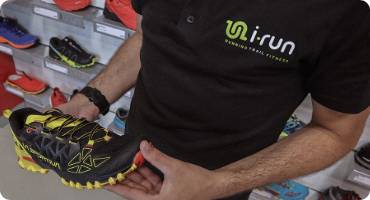
With so many brands and models available, it is not always easy to know where to start. Should you choose an entry level pair or invest straight away in a more technical model. It is tempting to focus on design or color, but wearing shoes that are not adapted to your needs can cause discomfort, pain or injury and reduce the pleasure of running.
In this guide, our experts share their advice to help you find your ideal pair of shoes to start running. With the right choice, you will enjoy every run with comfort, confidence and motivation.
1. Your terrain
The type of terrain you run on is a key factor when choosing running shoes. Whether you run in the forest, on a track or in the city, the surface impacts how your feet and joints absorb shock. This is where cushioning plays a major role. Cushioning refers to a shoe ability to absorb impact.
There are three main types of terrain, road, trail and track, and each requires specific footwear. Hard surfaces like asphalt or concrete offer little flexibility and demand shoes that protect your joints from repeated impacts. However, too much cushioning can reduce stability. Here are the main criteria to consider depending on your running surface.
- Road: optimal cushioning, greater stability, maximum comfort
- Trail: moderate cushioning, strong stability, reinforced foot support
- Running track: low cushioning, good stability, excellent grip
2. Frequency and distance of your training sessions
How often and how far you run also influences the choice of your running shoes. For shorter distances such as 5 km or 10 km, lighter shoes with less cushioning can provide a feeling of speed and responsiveness. For longer distances like marathons or ultra distances, shoes with strong stability and more cushioning are essential to maintain comfort over time.
3. What is your kind of stride?
To choose the right running shoes, it is important to understand your stride. While there is no perfect or normal stride, some types are more common than others.
There are three main stride types:
- The universal or neutral stride is the most common, affecting around 50 percent of runners. Impact is evenly distributed across the foot.
- The pronation stride affects around 45 percent of runners. In this case, the foot rolls inward when running.
- The supination stride is less common, affecting about 5 percent of runners. The foot rolls outward during impact.
To identify your stride, simply look at the wear pattern on an old pair of running shoes and compare it with the diagram below. Is the wear mostly on the inside, outside or center of the sole.
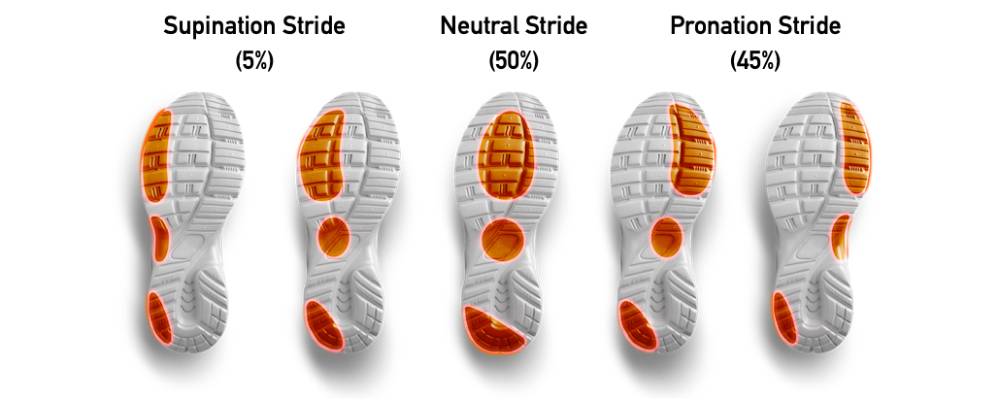
If the wear is on:
- the central part, your stride is neutral or universal;
- the inner part, you have a pronation stride;
- the outer part, you have a supination stride.
Once your stride is identified, you can choose shoes that provide the right level of support and cushioning. If you are unsure, our customer support team can help guide you.
4. Your size plus one equals the ideal size
During exercise, feet naturally swell, especially over longer distances. That is why it is recommended to choose running shoes one size larger than your usual size. Your shoes should fit securely without feeling tight, with good heel support and enough room for your toes to move freely.
This helps prevent friction, blisters and discomfort while allowing your feet to breathe more easily.
The right running shoes should feel comfortable from the first step and well adapted to your feet. The goal is to find a model that delivers the best sensations and confidence as you run.
Thanks to the tips shared in this guide, you now have all the essentials to choose the ideal shoes to start running.
Last but not least: equipment for runners
Congratulations, you have found the perfect pair of running shoes. But your equipment does not stop there.
Depending on the season, consider completing your running outfit with:
- a T shirt with short or long sleeves;
- shorts or tights;
- technical running socks.
Choose breathable and insulating clothing that keeps you warm without trapping moisture.
To help you make the right choices, discover the technical products selected by our experts.
With the right equipment and reliable advice, you are ready to start your running journey with confidence and enjoyment. Happy running.
YOU MIGHT ALSO LIKE...

How to take care of your running shoes?
Receiving a new pair of running shoes is always exciting. Since buying good running shoes can be expensive, proper care is necessary to avoid premature replacement and better for the environment.
Through this article, and with our expert tips, you can maintain your running shoes for as long as possible, keeping them clean and comfortable.
Running should be fun. To keep it that way, we've compiled 6 basic rules that show what's important for feeling good in sports and for optimal recovery/preparation.
To integrate running training into your routine, you should listen to your body, respect it, and start with a rhythm that is tailored to you.
What are good shoes for heavy runners?
Choosing the right pair of running shoes can improve your performance and reduce the risk of injury.
Heavy runners should pay particular attention to this weight criterion when choosing their shoes. Indeed, these shoes need to have additional reinforcement and cushioning to reduce the impact on the runner's joints and tendons.